"We don't have to accept this": Ireland urged to lead Europe's response to technology-facilitated sexual violence
28 November 2026
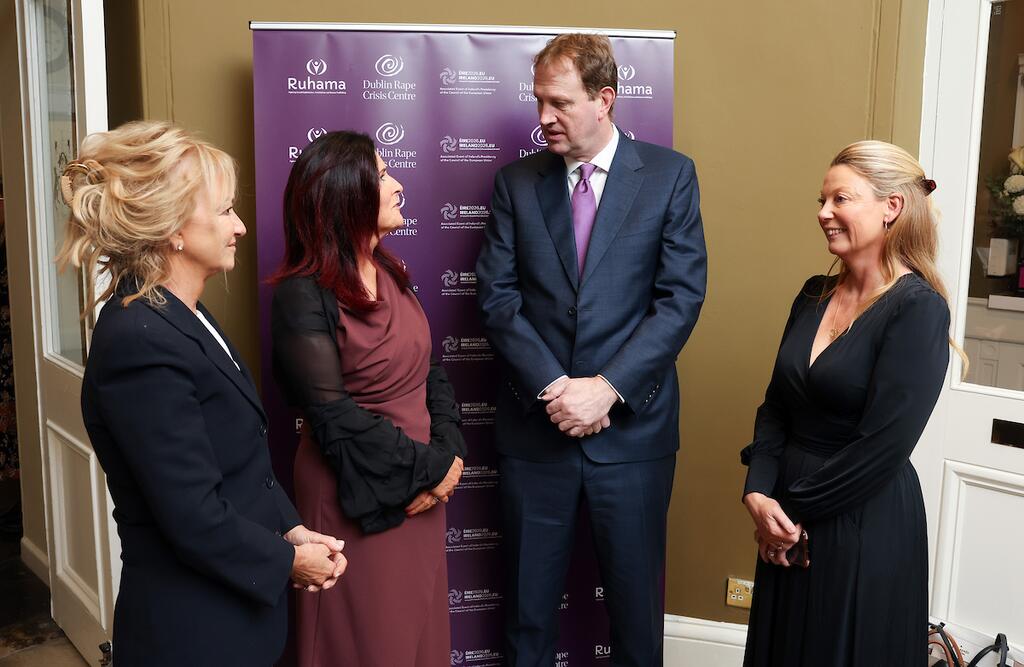
During the 2024 general election, Gráinne Seoige stood on doorsteps in Galway West asking for votes while a sexually explicit deepfake of her was being shared around the constituency. On Friday, she told a conference in Dublin what that was like. "I remember what went through my head: has he seen it, is he in a WhatsApp group where it's been sent, did he have a laugh about it, did he do anything else?"
"Somebody made a pornographic image of me using my face," she said. "I never posed for it, I never knew about it."
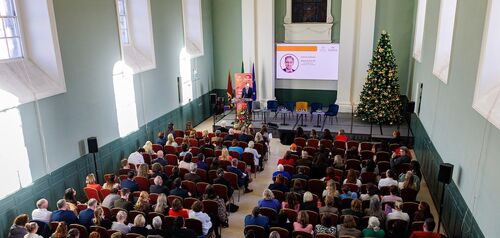
The survivor, journalist and broadcaster was the first speaker at Fostering an Equal Future, hosted by Dublin Rape Crisis Centre and Ruhama at the Law Society of Ireland on Friday 27 November as an associated event of Ireland's Presidency of the Council of the EU. The conference brought together survivors, ministers, law enforcement, legal and policy experts and frontline services from Ireland and across Europe. From very different starting points, they reached the same conclusions: this harm is real, it is designed in and profited from, and it can be prevented.
The harm is real
"I felt deeply humiliated and ashamed," Gráinne Seoige said. "I'm two years down the line, and it still stays with me." Making her documentary, Deepfake Ireland, she met others who had been targeted. "You try to avoid places where you know there will be people. These victims made their lives smaller, and I understand that."
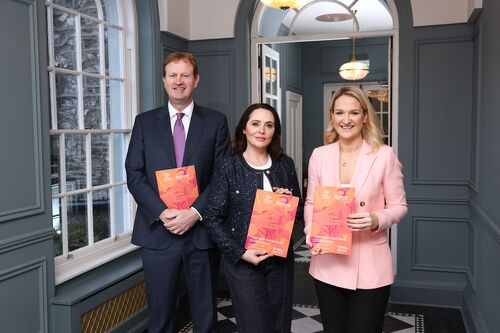
Rachel Morrogh, CEO of Dublin Rape Crisis Centre, said that experience is becoming more common. "On the front line we're seeing a significant increase in the number of people who are coming to us for support after tech-facilitated sexual violence. It's often perpetrated by people known to the victim. It's friends, it's family members. AI amplifies this beyond anything that we could recognise a few years ago."
"There is no online/offline division," she said. "Online violence is real violence."
Tánaiste Simon Harris TD agreed: "An image that is artificially generated does not make the harm any less real." Minister of State Catherine Ardagh TD, who closed the conference, described how the indelibility of the online world amplifies online harms: "The continued circulation of this material prolongs the trauma and compounds the impact," she said. "Digital sexual violence turns every screen into an ongoing crime scene."
The price of public life
Several speakers described this abuse as a way of pushing women out of public life. "Women like myself are told 'You put yourself up for this, you signed yourself up for this' by being in the public realm," Gráinne Seoige said. "I don't agree. Using sexual humiliation against a candidate needs to be treated like any other kind of election interference."
Minister for Justice, Home Affairs and Migration Jim O'Callaghan TD said that canvassing is hard for any candidate, "but I've never had to go to a door with the fear that Gráinne mentioned. That points to the very gendered nature of this abuse, and the attempt to deter women from being involved in politics."
Helen McEntee TD, Minister for Foreign Affairs and Trade, and Minister for Defence, has seen the effect directly. "Increasingly we are seeing online abuse being used deliberately to silence women. I spoke to many women who I hoped might have run for our party, but who decided not to do so because of the online abuse that they might be subjected to."
"Women are stepping back because the digital cost of participating in public life is a price they are no longer willing to pay," said Minister Ardagh. "We are not going to allow algorithms to keep us out of public life."
Human rights lawyer Caoilfhionn Gallagher KC said women journalists around the world have faced the same tactics for years. "Whether deepfakes or 'cheapfakes', they all share that same aim: to demean and discredit women in the public eye."
A product and a profit
If one idea ran through the day, it was that this is not an accident of technology.
"Many of the legal and policy responses tend to be focused on individual users, not the platforms or the products," said Caoilfhionn Gallagher. "This is a product safety issue." She went further: "Technology is actually driving this abuse. It's not a neutral facilitator."
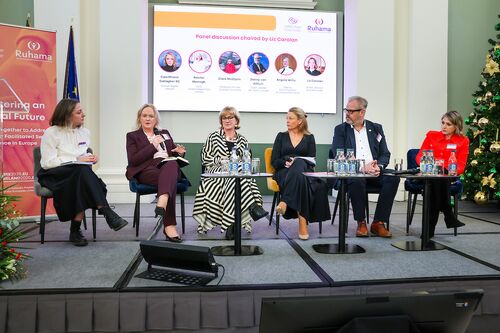
Professor Clare McGlynn of Durham University asked the question plainly: "What is the legitimate purpose of nudification apps?" She noted that the controversy in January over Grok, the AI tool on X, forced the issue onto the agenda, "but this had been faced for years."
Gráinne Seoige said it was that controversy that moved her to speak as publicly as she has. "I can't tell you about how much X earned from people who wanted to use that feature. I can tell you about the cost to women who were exposed."
"There is a business model that profits from this harm," said Rachel Morrogh. "No one is willing to grasp that nettle." She warned about the danger of regulatory capture through alarmism manufactured by the companies themselves: “A lot of AI companies earlier this year warned us that humankind was going to end. There was a lot of security theatre around that. The everyday harms that we see in Dublin Rape Crisis Centre and many of the frontline organisations here, harms that are experienced by normal people doing normal things are what we need to regulate for. The purported threat of the ‘end of humanity’ is a distraction.
The Tánaiste addressed the technology companies based in Ireland directly. "When a product is designed in a way that facilitates abuse, this is a decision," he said. Of the men who lead those companies, he said: "These men cannot be excused of their responsibility. That is what Irish society expects of men in positions of leadership. That does not end at the office door of a technology company."
Barbara Condon, CEO of Ruhama, put it in less than ten words: "Welfare and wellbeing must be prioritised over profits."
Laws and enforcement that keep pace
Ireland has not stood still. Minister O'Callaghan and Minister McEntee pointed to Coco's Law, which the latter brought forward: "Many EU member states are only now introducing that type of legislation that we introduced back in 2020," O’Callaghan said. Minister McEntee said a review found that more than 100 cases had been prosecuted by the end of 2023, with thousands of images taken down through Hotline.ie. Minister O'Callaghan added that Irish law already makes no distinction between a real sexual image of a child and one generated by AI, and said he hopes to bring forward legislation on violent pornography next year.
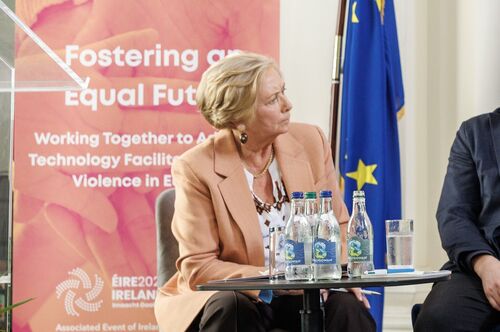
Europe has moved as well. The afternoon panel was chaired by Frances Fitzgerald, Ruhama Ambassador, former Tánaiste and former Minister for Justice. As an MEP, she was co-rapporteur for the EU's first directive on combating violence against women and domestic violence, adopted in 2024. It requires every member state to criminalise the non-consensual sharing of intimate or manipulated images, including deepfakes, along with cyberstalking and cyber harassment, by June 2027. Tánaiste Simon Harris also pointed to EU-wide prohibitions on AI systems that generate sexually explicit material of people without their consent, which apply from Wednesday 2 December.
But speakers were clear that law on paper is not enough. "Our laws have to keep pace with technology," the Tánaiste said. "Self-regulation is not going to work in this space. We should not be naive."
In England and Wales, creating a sexually explicit deepfake is now an offence in itself. "Creating that image without consent, that is the offence," said Professor McGlynn. "We have the legislation, but enforcement is the issue." She was critical of regulators handing of January’s Grok incident too: "It's unacceptable that both the EU Commission and the UK regulator Ofcom have taken over a year to investigate. We're still waiting for action."
Danny van Althuis of Europol described a huge spike in the volume of Child Sexual Abuse Material reaching investigators, much of it AI-generated and increasingly hard to tell from real images. Each file has to be examined until it is clear whether there is a child who needs to be found. "The spike in images creates a huge capacity issue," he said.
"It's a systemic problem that needs a systemic response," said Dr Katrin Mueller-Johnson of the University of Oxford. "Law enforcement needs more resources to get more skills to support victims."
Gráinne Seoige gave the gap its most memorable image: "The crime is in a Formula One car, and we are chasing after it in a tricycle." She also noted that fines against tech companies are ineffective, and the companies begin to build them into the baseline. Where the evidence establishes criminal responsibility on the part of company executives, she said, "I believe those executives should be prosecuted."
Prevention, men and boys
"When we come in investigating, the harm has already been caused," said Deputy Commissioner Angela Willis of An Garda Síochána. "We need to get ahead of it and make sure we have systems in place for prevention."
For Rachel Morrogh, that is the heart of it. "The only show in town is prevention. All sexual violence is 100% preventable. There's a fatalism around this, that we just have to accept this. But we don't have to accept this and we should not stand for it."
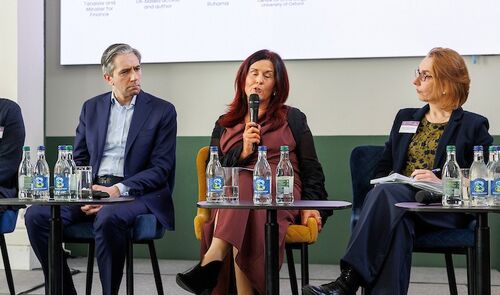
Prevention means looking at what boys and young men are being shown. "Technology didn't invent misogyny, but it has given those who promote it an increasing and frightening reach," the Tánaiste said. "We cannot allow online influencers to define for a generation of young boys what it means to be a man." Danny van Althuis described what that looks like from the inside: "Once trapped in an algorithm, the only thing that is fed to you on your device is this misformed type of masculinity."
"This isn't a women and girls problem, this is a men and boys problem," said Minister O'Callaghan. The Tánaiste put the responsibility in similar terms: "Women have already shown extraordinary leadership in tackling sexual violence. Men must match it."
Barbara Condon shared research showing that 70% of people recognise prostitution as exploitation, yet 46% of adults could name at least one circumstance in which they believed buying sex was acceptable. More than half saw pornography as a factor in normalising it. "We recognise the exploitation, but we rationalise the demand that sustains it," she said. "That's the uncomfortable starting point that we must confront."
Conference moderator Catherine Day, former Secretary General of the European Commission, added a caution about how that conversation is held. "We have to listen to young boys, to have a discussion where they are not lectured to from a podium."
Support for everyone affected
While much of the policy response so far to this issue has centred on children, Rachel Morrogh and Danny van Althuis both emphasised the importance of protecting all vulnerable people, even into adulthood and old age. "Vulnerability does not stop at 18," Danny van Althuis said, “social media is being used to hunt for vulnerable people who are vulnerable in all sorts of ways, also older people with financial exploitation, younger men who are being recruited by organised crime to travel and commit crimes all over Europe.”
Women and girls are disproportionately targeted. Speakers also described boys and men being blackmailed over intimate images, and adults of all ages being sought out online because they are vulnerable.
Deputy Commissioner Willis had practical advice for anyone who finds an intimate image of themselves online. Record the link and any details, do not share the image with anybody, report it to the platform, and contact An Garda Síochána or Hotline.ie. In around 96% of cases where Gardaí engage with Hotline.ie, she said, the content is removed, though "removing the image is not enough. That's only the starting point."
Support also depends on resources. "Organisations like Dublin Rape Crisis Centre are often operating on short term budgets, and we need to see more support for them," said Professor McGlynn. Dr Mueller-Johnson agreed: "Government has a role in making laws, but also in making sure there is funding for the groups that are working on this issue."
A Call to Action
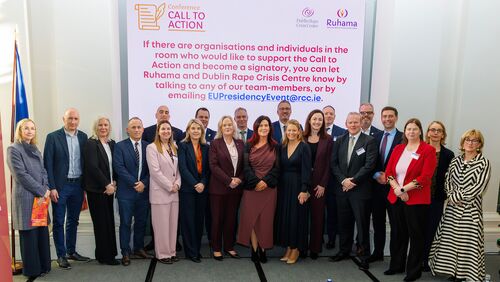
Minister McEntee launched the conference Call to Action, which is endorsed by the European Women's Lobby and members of its Observatory on Violence against Women. "Innovation and safety must go hand in hand," she said. "I encourage every single organisation, regulator and participant here today to sign up."
The Call to Action asks governments, regulators and partners at national, European and international levels to work together to hold the technology sector to account. It sets out four things technology companies must be required to deliver. The first is safety by design, with safety and users' rights built into digital products, services and algorithms from the outset. The second is platform and algorithmic accountability, including access to data, scrutiny of systems and measures to prevent sexual content being recommended and amplified, backed by effective oversight and enforcement. The third is protection and support for victims and survivors, with accessible reporting, rapid removal of harmful material and clear pathways to specialist support and justice. The fourth is measurable change, with independent monitoring and evidence that safety measures are working.
The public is already there. In research by Ipsos B&A for Dublin Rape Crisis Centre and Ruhama, 91% of people in Ireland said it is important that tech companies build safety measures into their products, and 52% said online platforms and tech companies hold the greatest responsibility for preventing this harm.
"An emergency response"
The day ended with a sense of urgency and of possibility. "There's an urgency to this. It's an emergency that requires an emergency response," the Tánaiste said. "Just treating this as one more issue on the laundry list will not be good enough." Minister O'Callaghan committed that the Government "will keep this front and centre during the remaining month of our presidency but also afterwards."
Caoilfhionn Gallagher reminded the room where it was sitting. "People power does work. And pressure does work. We can have a real impact here in Dublin because the tech companies are headquartered here in Dublin." While Catherine Day wrapped up the conference with an affirmation: "We don't have to accept this. It is possible to get change."
Dublin Rape Crisis Centre and Ruhama are inviting organisations and individuals to support the Call to Action.
If you have been affected by sexual violence of any kind, online or in person, Dublin Rape Crisis Centre's 24-hour National Helpline is free and confidential on 1800 77 8888. Ruhama's support line is 1800 020202 (office hours, 9am to 5pm).