We can't treat our way out of this – we have to stop it: Annual Report 2025 launch
26 May 2026
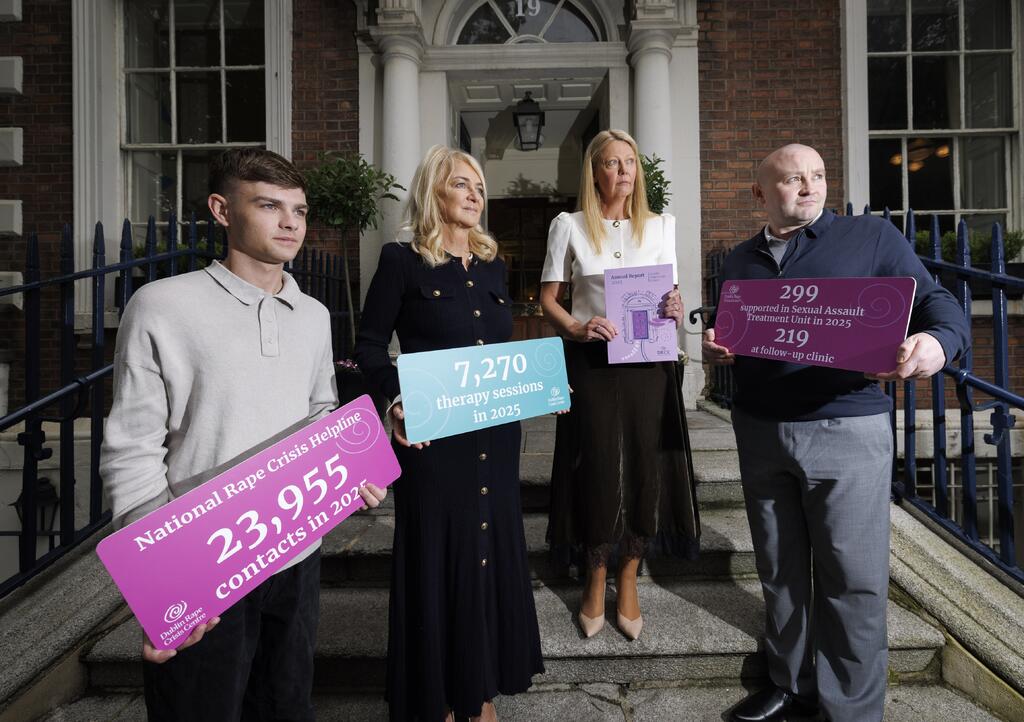
“We can't treat our way out of this”: at the launch of the Centre's Annual Report 2025, a record year of work was set against an accelerating demand for services and an unflinching account of the obstacles still in the way.
At the Royal Irish Academy on Dawson Street on Tuesday 19 May, Dublin Rape Crisis Centre launched its Annual Report 2025 before staff, volunteers, survivors, donors, partner organisations and members of the Oireachtas. Dr Stephanie O'Keeffe, Chief Executive of Cuan, the national agency for domestic, sexual and gender-based violence, spoke alongside the Centre's Chair, Anne Marie James, Chief Executive, Rachel Morrogh, and Minister for Justice Jim O'Callaghan TD, who launched the report.
The figures set the tone. Calls to the free and confidential 24-hour National Helpline rose by close to 30%, totalling near 23,955. The number of clients attending therapy reached 838, up 31% in a single year. Calls related to online and image-based abuse rose 63% on 2024.
“These are not just numbers,” said chairperson Anne Marie James. “Each call is a traumatised person at the end of the helpline.”
A record year of work
Ms James framed the launch as an exercise in accountability. “Today is the Board's day when we stand up and give account to our supporters, funders and partners in government and civil society,” she said. “However, it is the survivors, who have entrusted us with their stories to whom we are most accountable.”
In 2025 the Centre received the Human Rights Award from the Bar of Ireland for its advocacy on behalf of victims and survivors. The greatest achievement of the year, she said, was the sheer volume of work delivered, “all on time and within budget by a dedicated and committed workforce of staff and volunteers.”
“To the survivors, those here today in particular, whose courage in speaking out is deeply humbling,” she said. “You are at the centre of everything we do. You are the reason. We will not stop supporting you, advocating for you. We will not stop until our society and the system reflects the dignity that every one of you deserves.
War against sexual violence
Presenting the substance of the report, Chief Executive Rachel Morrogh argued that the trajectory on prevention had not turned.
“We see the enduring, pervasive nature of sexual violence across society reflected in this year’s figures,” she said, “but we do see a glimmer of hope that survivors feel more reassured and more confident about getting support and information from services like ours.”
Around one in three callers, she said, are under 39. Around six in ten clients attending therapy had been raped; nine in ten were women; around 60% of them were under 39. “If we were making the necessary progress in eliminating sexual violence, we'd hope to see those figures for younger people getting smaller,” Ms Morrogh said. “But actually they're getting bigger, so it's clear to us that this war against sexual violence is not one that we're winning.”
Around four in ten new counselling clients had experienced other forms of violence alongside sexual violence. One in three had been subjected to coercive control; around half had been physically abused; three in ten had been psychologically abused. One in six had been threatened with being killed, or had had an attempt made on their life. Six per cent had been strangled. Four per cent had a weapon used against them. A further four per cent had been stalked.
“The reality is that we're not going to be able to treat our way out of this problem," Ms Morrogh said. "We can't meet the demand. There is so much harm going on in society at the moment. We have to stop it.”
She invoked the four pillars of the Istanbul Convention, prevention, protection, prosecution and policy, as the framework still owed by the State to survivors. “The thing about sexual violence is that it's 100% preventable. It's somebody doing harm to somebody else. We can stop it.”
Three obstacles
The Chair set out three obstacles standing in the way of reducing sexual violence in Ireland: the proliferation of harmful online content, deterrents to reporting and conviction, and the state of judicial training.
On the first, Ms James cited evidence that 90% of mainstream free pornography of the kind young people in Ireland are exposed to contains physical acts of violence, that more than 94% of that violence is directed at women and girls, and that the Centre is seeing increasing numbers of clients presenting with strangulation and ligature marks and injuries from physical restraints.
“Young men are being groomed to become the unwitting perpetrators of violence and young women groomed to think they are expected to submit to it,” she said. “What is illegal offline must be illegal online.” She welcomed the Minister's stated commitment to act on the issue.
She called for the removal of the right of accused persons to view their accuser's counselling notes, describing the current arrangement as “a total violation of the confidentiality of the therapy session,” and renewed the Centre's call for statutory privilege to be granted to those notes.
On the third obstacle, she pointed to judges allowing rapists and violent offenders to walk free without a custodial sentence, repeat offenders remaining out on bail, and delays of up to five years or more before cases conclude. “Judicial training, more judges, and the full implementation of the Istanbul Convention are not optional,” she said. “They are urgent and they are obligatory.”
Zero Tolerance Strategy
Cuan CEO Dr Stephanie O'Keeffe acknowledged Dublin Rape Crisis Centre's 47 years of work supporting victims and survivors, and the role of the organisation in shaping the State's response.
“Many people in this room work directly with victims and survivors,” she said. “These people are at the end of the phone in the middle of the night, opening doors to counselling sessions, and helping the most vulnerable in our society to have their voices heard.”
She paid tribute to the survivors in the room. “I am always awed by the bravery of survivors: those who carry their trauma alone, those who share it, and those who use it to advocate for others who need support.”
Dr O'Keeffe set out Cuan's role as the national agency driving the implementation of Zero Tolerance, the Third National Strategy on domestic, sexual and gender-based violence, describing it as “an ambitious and comprehensive programme of work, delivered through a whole-of-government approach, in close collaboration with civil society and the domestic, sexual and gender-based violence sector.”
“Achieving our vision of creating a society entirely free from domestic, sexual and gender-based violence is increasingly challenging,” Dr O'Keeffe said. “But we in Cuan are steadfast in our belief that no one should ever have to face these experiences.”
She confirmed that work will begin this year on the Fourth National Strategy, which Cuan will facilitate. Consultation with civil society, the sector and victim-survivors is anticipated.
I want to live
The launch closed with the premiere of a short film featuring three survivors who used Dublin Rape Crisis Centre services in 2025: Jordan, ‘Tina’, and Tom. Each spoke to camera about their trauma and the work of recovery.
A personal story sits behind each of the 23,955 contacts to the National Helpline in 2025, behind each of the 7,270 therapy appointments, and behind each of the more than 500 accompaniment sessions to the Sexual Assault Treatment Unit and through the justice system. Tom, Jordan, and Tina had agreed to share theirs.
Tom, 38, a survivor of rape and of historical sexual abuse in childhood, recalled his first call to the helpline. “I just wanted someone to listen to me, to not interrupt me,” he said. Contact with the centre brought him to a realisation: “All the guilt and shame that I had and I was carrying, it wasn't mine, it was somebody else's. And it was time to give it back.” Of his life now, Tom says, after many years of struggling for justice: “I'm happy in myself again. I want to live.”
Jordan, 23, described the slow return of a self that had been displaced after an assault three years earlier in a nightclub. “Once I started opening up about it, I could slowly see the old self of me coming back. And that pure happiness I used to feel was coming back too.”
‘Tina’ closed her own contribution with a message to other survivors. “Just keep going and never give up. It's so important. It's simple words, but it's everything.”
- The Annual Report 2025 is available to download here: https://www.drcc.ie/news-resources/resources/dublin-rape-crisis-centre-annual-report-2025/
- You can read an overview of the key statistics here: https://www.drcc.ie/news-resources/resources/dublin-rape-crisis-centre-annual-report-2025-statistics-pullout/
If you have been affected by any of the issues raised in this article, you can call Dublin Rape Crisis Centre’s free and confidential 24-hour National Rape Crisis Helpline on 1800 77 8888.