Busiest year on record at Dublin Rape Crisis Centre as demand for support reaches unprecedented levels
19 May 2026
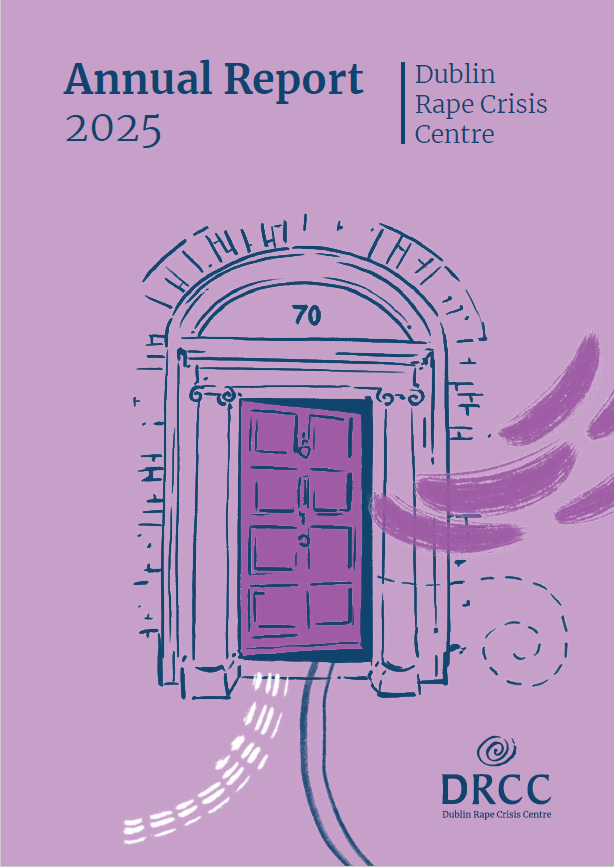
- Dublin Rape Crisis Centre National Helpline had 23,955 contacts in 2025, the highest ever recorded
- 838 people supported in therapy, up 31.5% on 2024 and up almost 70% over two years
- 7,270 therapy appointments delivered, compared with 5,800 in 2024
- Over 500 accompaniments at Sexual Assault Treatment Unit and 350 accompaniments in Garda and court settings
In 2025, Dublin Rape Crisis Centre (DRCC) recorded the busiest year in its 47-year history, with growth across every frontline service. The organisation publishes its Annual Report this lunchtime (Tuesday, 19 May 2026) and outlines the unprecedented levels of demand met by its teams.
Minister for Justice, Home Affairs and Migration, Jim O'Callaghan T.D., will launch the report in Dublin at noon in an event that includes addresses by Dr Stephanie O'Keeffe, Chief Executive of Cuan, the State’s domestic, sexual and gender-based violence agency, as well as Rachel Morrogh, DRCC’s Chairperson and CEO. The launch will also see the premiere of a video featuring some of the Centre’s clients.
The Minister for Justice, Home Affairs and Migration, Jim O’Callaghan, said:
“Dublin Rape Crisis Centre’s Annual Report for 2025 highlights both the scale of the challenge we continue to face to combat sexual violence as well as the extraordinary work being done by DRCC to support survivors and victims.
“The figures are stark, with DRCC’s helpline recording its highest ever number of contacts last year. The Report also points to a society more open to talking about sexual violence and survivors and victims more confident in coming forward seeking support.
“I commend the DRCC leadership team, staff and volunteers for their tireless work and commitment. I also want to acknowledge the courage of every survivor who reaches out for support, often for the first time.
“I remain firmly committed to continue strengthening services and legislation, supporting survivors, and driving lasting cultural change so we achieve zero tolerance for domestic, sexual and gender based violence in Irish society.”
Chief Executive of Dublin Rape Crisis Centre, Rachel Morrogh, said: "Last year was one of the most demanding and in many ways defining years in Dublin Rape Crisis Centre's history. Across our National Helpline, therapy and accompaniment services in 2025, demand reached levels we have not previously seen, making this the busiest year ever for the organisation.
"Our specialised therapy service experienced unprecedented demand last year. We supported 838 therapy clients, a 31.5% increase on 2024 and a rise of almost 70% over two years. Looking at how this rise in the number of clients affected the number of therapy sessions our therapists delivered last year, we can see the figure grow to almost 7,300 therapy appointments, a very significant increase of just under 23% from 5,916 in 2024.
"The National Rape Crisis Helpline fielded an extraordinary 23,955 contacts – up over 5% from 2024 and a 29% increase from 2023. This signals a clear and continuing upward trend in people seeking support. Of those callers who told us whether they were a first time or repeat callers, 6 in 10 had called us before and 4 in 10 were first-time callers. This tells us that people need the ongoing telephone counselling support the National Helpline offers and that we are a constant and reliable support for callers from across the country. I'm always mindful of the courage it takes to pick up the phone for the first time, to find the words to say out loud. We thank each and every one for their trust in us.
"Dublin Rape Crisis Centre’s accompaniment service is there for people at the points on their journey we know to be particularly hard and we were pleased to see a sharp rise in the number seeking this type of support last year because it means fewer survivors are facing these very difficult challenges alone. In 2025, we carried out 850 accompaniment sessions across Sexual Assault Treatment Unit (SATU), Garda and court settings. Accompaniment support at the SATU in Dublin’s Rotunda Hospital increased by 34% over 2024. Behind each of these figures is a person facing some of the most intimidating, devastating moments of their lives, and our accompaniment team's presence ensured that none of them had to navigate medical or justice processes alone.
"Above all, I want to acknowledge the courage of every person who reached out to us in 2025, while recognising that there are many more survivors who are still carrying the trauma of sexual violence alone."
Chairperson of the organisation's Board of Directors, Anne Marie James, said: "I am proud of the dedicated, unstinting and increasing work of Dublin Rape Crisis Centre throughout 2025. It is clear that people need our services and supports more than ever before.
“Responding to these needs requires flexibility, resilience, and a continued commitment to maintaining the highest standards of care – qualities demonstrated consistently by our staff and volunteers during the year. Despite the challenges that increased demand places on our services and staff, and how emerging issues such as deepfake imagery and other forms of online sexual violence underscore the ongoing need for legal and social reform, Dublin Rape Crisis Centre continues to advocate on behalf of all victims and survivors of sexual violence.”
Free and confidential support for anyone affected by sexual violence is available on the 24-hour National Rape Crisis Helpline 1800 77 8888.
/ENDS.
Notes for editors:
- Dublin Rape Crisis Centre is a non-governmental, voluntary organisation which has as its mission to prevent the harm and heal the trauma of rape. It offers a suite of services to victims/survivors of sexual violence. It also offers a wide range of training and education to professionals and volunteers.
- The Annual Report for 2025 will be available to download from the website at drcc.ie following the launch from 2pm. A top-line list of headline statistics will be available at the same URL.
- We-Consent is a long-term national programme to inform, educate and engage with all members of our society about consent. More information and resources at https://www.we-consent.ie/
- Other DRCC services and work:
- DRCC operates the National 24-hour Helpline 1800 778888 to support anyone affected by sexual violence in any part of the country. A webchat support service is available online at drcc.ie Mon-Fri, 10am-5pm. A Helpline Interpreting Service is available for those who do not speak English - more at https://bit.ly/DRCClang
- For those contacting the Helpline who are deaf or hard of hearing, we provide a text service, operating Mon-Fri from 8am to 6:30pm, at 086-8238443 and we also have a webchat service available Monday-Friday, 10am to 5pm, except holidays.
- Information on your options after sexual violence is available for free online at any time at drcc.ie/fyw in the Finding Your Way after Sexual Violence guide.
- DRCC offers counselling & therapy to adult survivors of sexual violence and to older adolescents from 16 years of age with parental/guardian consent.
- We provide accompaniment support for the Rotunda Sexual Assault Treatment Unit, to court or to Garda stations to people in Dublin and in surrounding areas, by arrangement.
- We have outreach offices at Coolock, Dóchas Women’s Centre, Balbriggan & Tallaght. Access to these services must be arranged via the National Helpline 1800 778888 during working hours, Mon-Fri.
- We ask that when reporting on this topic, journalists should remember that discussions on sexual violence can trigger personal trauma in those receiving the information. Where possible, please make reference to the National 24-hour Helpline 1800 77 88 88 for anyone who may be affected by the discussion.